
Insulating the conservatory roof can be a great way to reduce the temperature fluctuations common in a conservatory without spending out extreme amounts of money to alter the conservatory structure (by fitting tiled roofing for example). Insulating the conservatory roof can also lessen other issues such as damp, mould and condensation, glare and furniture fading by lowering the amount of sunlight that is directly on the furniture inside the conservatory. But how does conservatory roof insulation work?
Insulation is essentially the use of dead air space or air trapped by cells to slow transference of heat (The Green Age). Different materials can be used, including glass wool, foam, sheep’s wool and can come in different forms, from rolls of wadding, sprayed foam, or boards. Some of these, the boards for example, may also have reflective layers on them to reflect the light and heat away and increase the insulating properties.
To understand how insulation works, it’s useful to understand what heat is and how it moves.
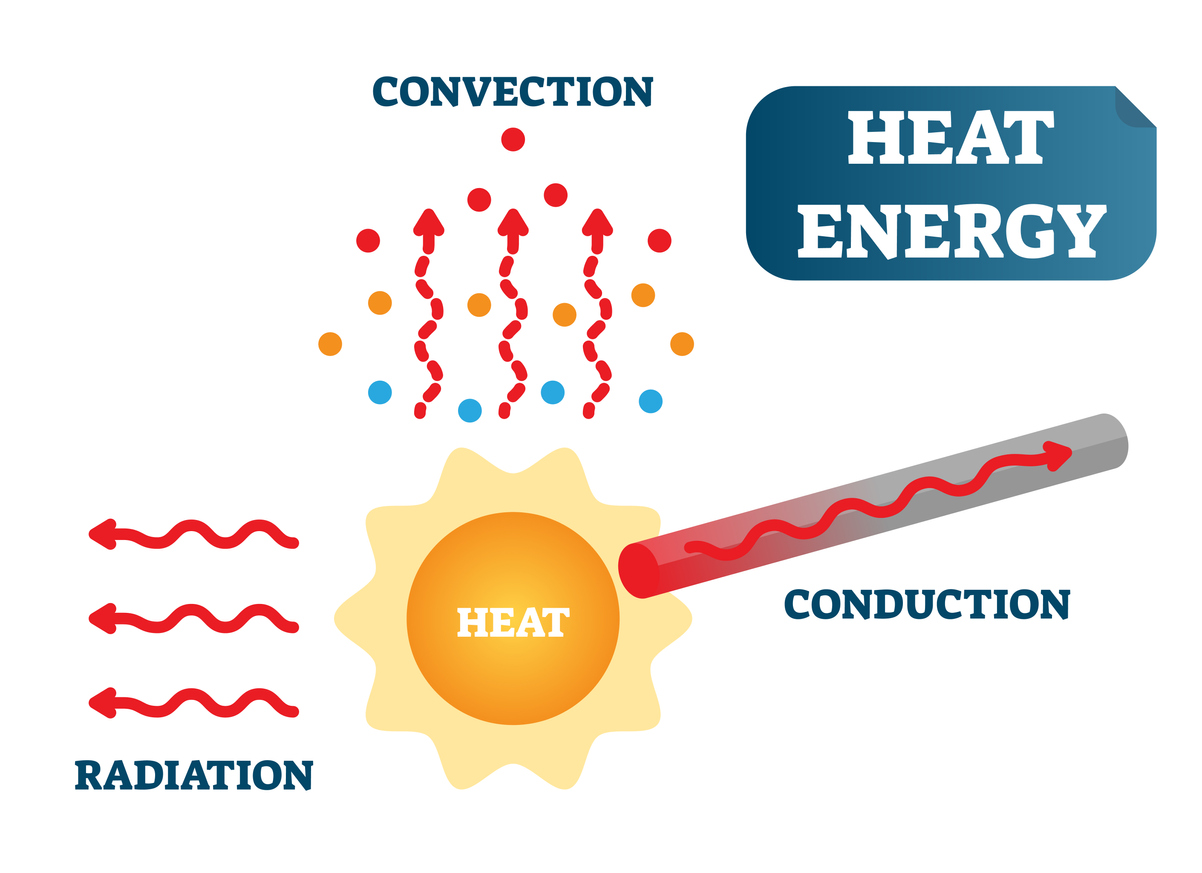
When a solid, gas or liquid is hot, the atoms or molecules making up the matter are moving fast or vibrating. The particles making up the hot mass will vibrate and spread as far as they can with their confines: “In a liquid, atoms and molecules are free to flow from place to place. Within a gas, they are even more free to move and will completely spread out within the volume in which they are trapped.” (Science News For Students).
These vibrating atoms or molecules move and ‘bump’ into other particles, sharing their energy and making those particles move too. Heat travels in three ways: convection, conduction, and radiation, but always from hot to cold as the moving hot particles bump into the stationary cold particles and share their energy.
Convection is the process where heat rises because the hot particles have more space between them and take up more volume meaning that the liquid or gas becomes less dense so it rises. In a conservatory in the winter, the hot air in the home from the homes heating will rise towards the roof and, if the conservatory roof is uninsulated it will pass through the roof material and outside. Heat can still transfer through the conservatory windows however and not just the roof, but heat convection means that a lot of heat is lost through the conservatory roof.
Insulation helps to slow this process by forming a barrier that the ‘hot’ or vibrating particles become trapped in. This stops them from bumping into or ‘sharing their energy’ with the particles on the other side of the barrier and therefore slows the heat transfer and keeps the heat energy with the particles that are already hot.
In terms of conservatory roof insulation, the insulation in the roof creates a barrier which stops the hot air particles inside the conservatory from transferring energy to the cold air outside in the winter, and in the summer, it stops the hot air particles from transferring heat energy from outside into the conservatory.
U-Values
The rate of heat transfer, or how well insulation is working, is classified as a material’s U-Value. The lower the U-Value, the lower the rate of heat being transferred through the insulation and therefore the better the insulation is. For comparison, your generic 8 inch brick has a U-Value of 0.41, whilst a single pane of glass has a u-value of 1.22, showing that the glass allows more heat energy to pass through it to the cold particles. To make a conservatory warmer, or to make a conservatory colder, the materials the conservatory is made from need be materials with a low U-Value and particularly the conservatory roof due to convection.
Conservatory Roof Insulation
There are many different conservatory roof insulation options for homeowners to choose from. From insulating panels like Green Space Uk’s Thermotec Panels, to fitting insulating quilting or wadding underneath the current panels.
Insulating panels are one of the most effective options to insulate the conservatory roof. Thick insulation, between layers of protective aluminium mean that it is strong and has a long life-expectancy. The thick insulation works to slow down heat transference making the conservatory warmer in winter or making the conservatory colder in summer. Green Space Uk’s Thermotec panels have a U-Value of 0.29 which, compared to polycarbonates 3.8 U-Value and Triple Glazing’s 1.2 shows how proficient these panels are. When the heat rises the conservatory roof insulation works to block the heat in, or in the summer it keeps the heat out of the conservatory, to make the conservatory warmer or cooler. Another benefit of this conservatory roof insulation is that it also helps to block sounds as well as heat, dampening the noises from cars, building work, dogs and bad weather and lessening the amount of disruption these noises can cause in the home. The strong aluminium casing also protects the conservatory roof from damage and deterioration.
These panels are made bespoke to fit in the current framework, with installers simply removing the old roof panels and replacing them with the new insulating ones, most of this can be done from the outside. This means that installation is quick, clean and unintrusive.
Insulating wadding or quilting is normally fixed under the current panels or glass and can then be covered with wood panelling, pvc panelling, or plasterboards to create a more aesthetic look. Sometimes this wadding or padding has a reflective layer to it so also help reflect heat in or out of the conservatory. This wadding can come in different thicknesses and isn’t always solid like the insulation inside the insulating panels. This can be slightly more intrusive to install as fitters will need to be inside the conservatory for the whole process, and if they are fitting cladding it can take longer to complete.
Conservatory roof blinds or curtains can also offer some level of conservatory roof insulation as the material helps to create an extra barrier that the heat particles get slowed down by. The thickness of the blinds will determine how effective the insulating abilities are but generally this isn’t as effective a method of insulating the conservatory roof.
Another option for insulating a conservatory roof is to replace the roof completely with tiled roofing. This will involve possibly removing the current roof completely and replacing it, or reenforcing it, with new framework to which tiles will be fitted. Like with a normal house roof this can be clad inside with plasterboards and insulation. This can be a longer and more intrusive process than the insulating roof panels, however the tiled roofing does make a thick barrier to help lower heat transfer.
Thicker polycarbonate panels, or triple glazing can also be installed and may offer a higher level of insulation that regular polycarbonate or panes of glass, though the U-Values are still lower than Insulating Roof Panels.


